Not on the default settings. A zombie bite always carries the Knox infection — the game sets it with no dice roll — and the infection kills in 48–72 in-game hours. Only a custom sandbox with Transmission set to "None", or Infection Mortality set to "Never", lets you live through one.
How long does a laceration take to heal?
About 1.2–2.3 h of real time if you bandage it — 19–37 h in game at the default day length (1 Hour 30 Minutes of real time per day). Left open it heals 50 times slower.
Timers, rates, odds and treatment effects read from the Build 42 server's code and scripts (23 Sept 2026); how each wound happens is adapted from PZwiki, Health (CC BY-NC-SA 3.0, shared under the same licence). How the times are worked out.
Times are for a character with neither healer trait, on Normal injury severity (Low multiplies the timers by 0.5, High by 1.5; bites ignore the setting) and the default day length (1 Hour 30 Minutes of real time per day). Healing runs on real time, so the “real” figure holds on any day length; the in-game figure scales with it.
Scratch
Health panel: Scratched
Knox 7%
A zombie's hands, smashing or crawling through a window, a failed vault, a crash, a fall.
Bandaged
16–35 min real · 4.3–9.3 h in game
Left open
4.1–8.7 h real · 2.7–5.8 days in game15× slower
Hurts while untreated
1
Bandage it — that is the whole treatment.
2
Optional: a plantain poultice under the bandage heals it 67% faster while it lasts.
Punching or climbing through glass, a fall, a crash, an axe — and what is left after a bullet or shard comes out.
Bandaged, not stitched
4.3–5.8 h real · 2.9–3.9 days in game
Without a bandage
never fully closes — the timer stops at 3
Hurts while untreated
1
Stitch it: the deep wound closes at once and stops bleeding. A suture needle adds 10 pain, a needle and thread 20 (minus your First Aid level). Stitching can start a wound infection — 1 in 5 at First Aid 0, 1 in 30 at 10.
2
Leave the stitches in: they set over time (faster under a bandage). Pulled out before they reach 40 of 50, the deep wound comes back; after that, only a scratch is left.
3
No needle? A bandage alone closes it, slowly. Without a bandage it never closes: the timer stops at 3.
Breaking a window bare-handed, climbing through broken glass, walking on it barefoot.
Glass out, bandaged
4.3–5.8 h real · 2.9–3.9 days in game
Without a bandage
never fully closes — the timer stops at 3
Hurts while untreated
1
Pull the glass out (PZwiki: tweezers or bare hands). It adds 30 pain minus your First Aid level, and bare hands add more. While the glass is in, the wound cannot close and keeps bleeding.
2
Stitch it: the deep wound closes at once and stops bleeding. A suture needle adds 10 pain, a needle and thread 20 (minus your First Aid level). Stitching can start a wound infection — 1 in 5 at First Aid 0, 1 in 30 at 10.
Get the bullet out (PZwiki: tweezers). It hurts — 80 pain minus your First Aid level — and leaves a deep wound whose timer is shorter by half your First Aid level.
2
Stitch it: the deep wound closes at once and stops bleeding. A suture needle adds 10 pain, a needle and thread 20 (minus your First Aid level). Stitching can start a wound infection — 1 in 5 at First Aid 0, 1 in 30 at 10.
3
Bandage it. While the bullet is still in, it does as much damage as an open deep wound.
Bandage it and keep it bandaged — open, it heals 20 times slower.
2
Every 20 points of healing it needs cleaning again ("Need Cleaning" in the health panel): clean it with a fresh bandage — 60 pain minus your First Aid level. An uncleaned burn raises the infection risk.
Healing timer 50–100
Fracture
Health panel: Fracture
No Knox risk
Falling from above the ground floor, a hard crash, a blunt weapon.
Splinted, First Aid 0
12–18 h real · 7.7–12 days in game
Splinted, First Aid 5 / 10
31–49 h / 17–27 h in game
No splint
58–91 h real · 39–61 days in game5× slower
Hurts while untreated
1
Splint it — a ready splint, or a ripped sheet and a plank or branch. The splint's strength is (First Aid + 1) ÷ 2, so skill matters: at First Aid 10 a splinted bone heals 55× faster than an unsplinted one, at 0 only 5×.
2
A comfrey poultice adds the unsplinted healing rate on top while it lasts — it stacks with the splint.
Healing timer 50–79 (a fall)
The Knox infection: bites, scratches and turning
Only wounds a zombie inflicts can carry it. The game rolls once, when the wound happens: a scratch infects you 7% of the time, a laceration 25%, and a bite always — bites skip the roll. Nothing in the health panel shows it, and nothing cures it.
What a zombie's hit turns into
One zombie, a hit that gets through to the skin, Rear Vulnerability at the default “High”. Each extra zombie attacking at once pushes the odds further toward bites.
From the frontKnox chance per wound 25%
57%29%14%
Scratch 57% · laceration 29% · bite 14%
From the sideKnox chance per wound 35%
31%48%21%
Scratch 31% · laceration 48% · bite 21%
From behindKnox chance per wound 51%
19%42%39%
Scratch 19% · laceration 42% · bite 39%
From infection to death
On the default Infection Mortality (“2-3 Days”) the game picks a lifespan of 48–72 in-game hours at the moment of infection (Resilient stretches it ×1.25, Prone to Illness shortens it ×0.75). The infection then climbs in a straight line until it is complete; the Sick moodle shows it, and your health is held under a ceiling that falls slowly at first and fast at the end. When it completes, the game deals 110 damage — death, then you rise.
Queasy12–18 h after infectionhealth held under 100%
Nauseous24–36 h after infectionhealth held under 94%
Sick36–54 h after infectionhealth held under 68%
Fever43–65 h after infectionhealth held under 34%
Queasy: food poisoning or zombification?
The game cannot tell you, by design. The Sick moodle shows the highest of three hidden values — zombie infection, food sickness and the “fake” infection — plus general sickness from rotting corpses, so Queasy looks the same whatever the cause. What separates them:
Zombie infection only climbs, on the schedule above, and pulls your health down with it. If Queasy shows up 12–18 hours after a bite, scratch or laceration from a zombie, that is the likeliest reading.
Food sickness comes from raw, rotten or poisoned food and tainted water, and wears off — it goes down when nothing new is adding to it.
Fake infection is what a Knox roll becomes when Infection Mortality is “Never”: it climbs, peaks, then drains twice as fast as it rose.
More on the Sick moodle and its levels on the moodles page.
The sandbox settings that change it
Transmission
Blood and Saliva(default)bites 100%, lacerations 25%, scratches 7%
Infection Mortality — time to death, as the code picks it
Instantat once
0-30 Seconds0–30 s
0-1 Minutes30–60 s
0-12 Hours3–12 h
2-3 Days(default)48–72 h
1-2 Weeks168–336 h
Nevernever — fake infection
Ordinary wound infection — the curable kind
A wound marked Infected in the health panel is not the Knox infection. While a wound is open the game rolls for it constantly — 1 in 40,000 each update, minus a weight for everything below, never better odds than 1 in 5,000. A sterilized bandage, while it is still clean, skips the roll entirely.
A dirty bandage−35,000
A deep wound−30,000
A laceration−25,000
Glass still in the wound−24,000
Bloody clothing over it−24,000
A burn−23,000
A scratch−20,000
Dirty clothing over it−20,000
No bandage−10,000
A burn that needs cleaning (on top)−7,000
To clear it: disinfect the wound (Bottle of Disinfectant, Alcohol Wipes), take Antibiotics, or put on a Wild Garlic Poultice — each one lowers the infection while it works, and they stack. A sterilized bandage on an infected wound lowers it too.
Bandages: how long each stays clean
A bandage's life is a random 0.5–1 × (First Aid + 1), plus the item's own bandage power. It wears down faster on a bleeding or deep wound; at zero it is dirty, and a dirty bandage is the single worst thing for infection above — change it. A dirty strip put back on starts at zero.
Bandage (Sterilized)power 4 · sterilized — no infection roll while clean
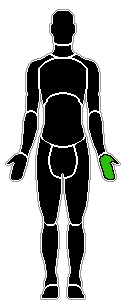
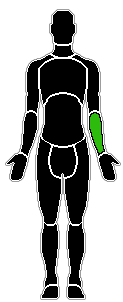
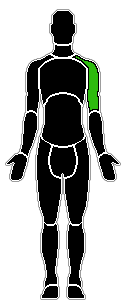
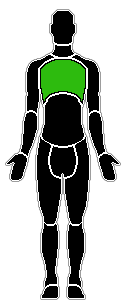
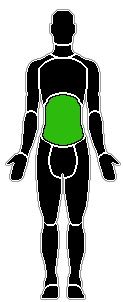
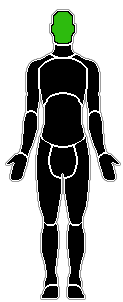
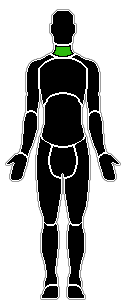
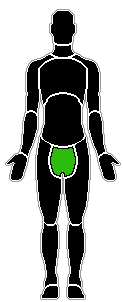
The game weights every wound by where it lands. Bleeding lasts longest on the neck and head and shortest on the hands and feet; pain follows the same pattern. Left and right are identical.
Handbleeding ×0.2pain ×0.5
Forearmbleeding ×0.3pain ×0.6
Upper Armbleeding ×0.4pain ×0.6
Upper Torsobleeding ×0.5pain ×0.7
Lower Torsobleeding ×0.9pain ×0.78
Headbleeding ×1pain ×0.8
Neckbleeding ×1.5pain ×0.8
Groinbleeding ×0.5pain ×0.7
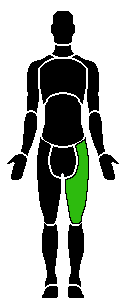
Thighbleeding ×0.4pain ×0.7
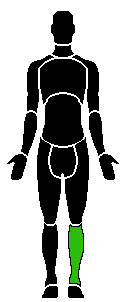
Shinbleeding ×0.3pain ×0.6
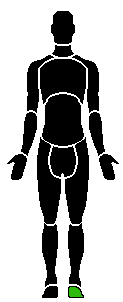
Footbleeding ×0.2pain ×0.5
The health panel (the heart icon, or H) reads overall health as OK, then Slight, Very Minor, Minor, Moderate, Severe and Very Severe damage in 10% steps down to 40%, Critical to 20%, Highly Critical to 10% and Terminal below that (adapted from PZwiki, Health).
What to carry, and where it spawns
Each name opens the map's item finder on the loot tables; the command spawns it on a server where you are admin.
Each wound gets a healing timer when it happens (the “healing timer” on each card — PZwiki lists these same numbers as hours). Every update the game takes a fixed amount off it — more when the wound is bandaged, splinted or poulticed — scaled by the same multiplier that moves the clock. The clock moves one in-game hour per 3.75 real minutes on the default day, so a timer T at rate r runs out in T ÷ (2,880 × r) real minutes on any day length. This assumes the body is updated once per game tick, as the character update does; times are rounded.
A scratch gets one of three timers, by what caused it — the game has a separate routine for a zombie's scratch, a weapon's and a window's (zombie 7–15, weapon 5–10, window 12–20). The Scratch card's times use the zombie one; only that one rolls the Knox infection. The window routine first rolls one in 7: on that roll you get a lodged glass shard instead of a scratch.
Pictures: item and trait icons and the health-panel figure are The Indie Stone's game art; item renders and shop signs are from PZwiki (CC BY-NC-SA 3.0).
Project Zomboid is a game by The Indie Stone. PinDrop is fan-made and not affiliated with The Indie Stone.
Cookies.
We use essential cookies to keep auth and voting working. Optional analytics + error tracking help us improve. Choose what you're OK with — Essential + optional analytics. policycookie policy.



 Bandage it — that is the whole treatment.
 Optional: a plantain poultice under the bandage heals it 67% faster while it lasts.